Showing posts with label Makerspace. Show all posts

Sunday, January 3, 2016

Littleton Common Makers Now Open


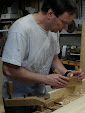
Matt Filipski, my first student at Littleton Common Makers, tests out a chisel he's learning to sharpen by hand on oilstones.

I'm very excited to announce that Littleton Common Makers is now open! This is the makerspace I first wrote about in this blog post.

The purpose of a makerspace is to provide a workspace and community for people who like to make things, but don't have space or equipment of their own to do it. This covers the whole range of making, from low-tech to high-tech, for hobbyists and professionals.

One of the real values in a makerspace is that it provides access to a number of disciplines and facilitates cross-pollination across them. This includes electronics, robotics, woodworking, metalworking, fabric arts, plastics, leather, jewelry making, the list is endless.

Littleton Common Makers (LCM) is available for member use, with classes open to the general public. It's currently limited to age 18 and above. It's an evolving work in progress, so capabilities and options will change over time.

All the credit for making this happen goes to my friend Faisal Mohammed. He had the dream and put in all the work to find a space, pay the rent, secure insurance and other paperwork, organize and administer membership, and prepare everything for use. He's the one who's made the initial investment in this community resource. The more of us who join him, the better it will be!

The Littleton Common Makers website is www.LCMakers.com. Like LCM itself, the website is a work in progress. For all inquiries, send email to info@LCMakers.com.

The Lowell Sun has also published a nice article about Faisal and LCM here.

Getting There

Littleton Common Makers is located in The Littleton Mill, just off Littleton Common, at 410 Great Rd, Littleton, MA, right by the Rt. 119 exit off Interstate 495 (map here).

The main parking lot is near the traffic light at the eastern end of the 495 overpass. There are a number of entrances to the building. The proper one to reach LCM is up the small outside stairwell with the signs for Dolphin Insulation, New England Yoga, and Indoor Batting Cages.


Look for the second-floor entrance from the deck at the top of these stairs from the parking lot.

It's a maze inside to reach the space, so look for the signs to Littleton Common Makers. From the entrance:
  1. Go straight to the end of the hall, past the batting cages on the right. 
  2. Turn left.
  3. Go to the end of the hall, through a small tunnel into the older building.
  4. At the Victory Liberty Loan poster go up the stairs on the right.
  5. At the top of the stairs turn left and left again to the hall behind the stairs.
  6. Turn left again.
  7. Head in the direction away from the orange double doors.
  8. Head to the end of the hall.
  9. Go up the stairs.
  10. At the top of the stairs turn right.
  11. Head to the red double doors.
  12. LCM is the white door to the right of the red double doors.
Open House Nights

Faisal has a standing open house at LCM every Thursday from 6-8pm. (subject to cancellation, check www.LCMakers.com or send email to info@LCMakers.com to confirm).

Equipment

A variety of equipment covering a range of maker disciplines and crafts is available for use by anyone who has completed the required training and been checked off in its use.

Some equipment has metered usage to ensure fair access and manage wear and duty cycle. Some has associated materials cost.

Training classes will be offered at modest cost to ensure proper usage to avoid injury or damage.

Current equipment includes:
  • Workbenches
  • Woodworking hand tools
  • Electronics worktable
  • Laser cutter
  • 3D printer
  • Sewing machine
Note that most of the equipment is member-owned and rented to the makerspace. Like me, other members had things in their basement and garage workshops that they wanted to move to a more publicly-accessible location. Renting the equipment out helps cover the cost of ownership. Some of it is lighter-duty consumer-grade, some is heavier-duty industrial/professional-grade.

Is there some equipment you'd like to place at Littleton Common Makers? If so, you should consider becoming a member!

Membership

Membership is on a monthly basis, payable by credit card online via Square, or by check. Depending on membership level, members enjoy access to the space (controlled by RFID key), storage, time allotments and discounts on metered equipment, and discounts on classes.

There are currently three levels:
  • Full membership, $75/month. This offers 24/7 access, with storage.
  • Partial membership, $50/month. This offers limited access (weekdays 6-8pm, weekends 9am-5pm), and no storage (all work is "bring in, take out").
  • Military and emergency personnel discount membership available.
To join or for further details, send email to info@LCMakers.com.

Note that partial member hours will expand as membership grows, since a full member must be present.

Woodworking Classes

This is where I will now be teaching my hand tool woodworking classes, both paid private and group classes and free classes for veterans. If you're interested in any of these classes, you can leave a message at 978-772-0030 or send me an email at sdbranam@gmail.com.

I've moved my four Paul Sellers-style student workbenches out of my basement workshop to the space, and once I get fully organized, I'll have all of my student tools there as well.

This means that these tools will also be available to members who have completed training. I offer the following training class:
  • 3 hours of hands-on instruction for $64 (includes $10 materials fee).
  • An additional hour of hands-on practice time is available for $18.
  • Covers basic use and handling of the following unpowered hand tools:
    • Workbench and work-holding
    • Handsaws
    • Handplanes (including router plane)
    • Chisels
    • Measuring and marking tools
    • Sharpening tools
This is an intensive boot-camp style introduction to these tools, just enough to get you working safely and effectively on your own. The optional additional hour of practice gives you a chance to spend more time getting used to them with an instructor present. The class does not provide detailed coverage of woodworking techniques; for that, I offer full instruction.

Other Classes

Other instructors will be offering classes in their areas of expertise. As noted above, some of these classes are required before you are allowed to use the covered equipment.

Is there a class you'd like to teach at Littleton Common Makers? If so, you should consider becoming a member!

About The Location


Faisal working at the electronics table. The windows to his right look out onto the IBM building.


Matt working at the workbenches. The windows behind him look out toward Littleton Common.


The laser cutter with some laser-cut and laser-engraved wooden parts. This vents exhaust smoke out a tube in the window, an example of why you need a workshop to use this kind of equipments.

Faisal's original plan was to have the space in Ayer, because wouldn't it be great if it was 5 minutes from home? Unfortunately, there was no suitable venue that was affordable for a budding makerspace. By necessity it has to start small, then grow with success. Fortunately, Littleton is the next town over, so it's just another 7 minutes down the road.

The Littleton Mill is an old mill complex that's been converted into mixed use suites. Other occupants include a community theater, various one-room workshops and studios, small manufacturers, even indoor batting cages! Like all such old mills throughout New England, the place is a maze of buildings of various vintage, corridors, and stairwells, so it's easy to get lost.

I actually used to work right across the street back in the 90's at the King St. Digital Equipment Corporation facility (old DECcies still fondly refer to it as LKG). That later became Compaq, then HP, and is now IBM (you can see it from the makerspace's north-side windows). Ironically, Faisal is an engineer at a company in another old mill related to DEC, Clocktower Place in Maynard, MA. Known simply as "the mill", this was DEC's headquarters from 1957 to 1992. This area is a major part of the Boston 495 high tech corridor.

LCM currently occupies a single 650 sq. ft. room at the eastern corner of the complex (nearest the intersection of Rts. 119 and 110). As the membership and equipment grows, Faisal will rent additional suites, with the expectation that this room will become the "clean room" for hand tool woodworking and classroom space. The noisier and messier equipment will be located in the added space.

The building already has a well-established woodworking presence: my friend Freddy Roman, professional woodworker and restorer, has his workshop downstairs. I wrote a profile of Freddy several years ago here. At that time, he was sharing another suite in the building with renowned woodworker Will Neptune. Prior to Freddy and Will, that workshop was occupied by guitar-maker Julius Borges.

If you live in the area and are interested in tinkering with some of these things, join LCM or take some classes there!

Sunday, June 29, 2014

Ayer Makerspace Initial Meeting


Faisal Mohammed giving a presentation to about 25 attendees. Some of his Arduino-based robots are on the table next to him.

Ayer, MA Makerspace

Something I'm very excited about, the Ayer (MA) Office of Economic Development is investigating bringing a makerspace to town. Their first public meeting on it to gauge interest was this past Thursday night.

The main presenter was Faisal Mohammed, a local software engineer and Arduino enthusiast. The meeting was organized by David Maher of the Ayer OED.

There were about 25 people in attendance, a mix of local high- and low-tech makers covering paintings, jewelry, fiber arts, welding and metal fabrication, woodworking, 3-D printing, and CNC routing and machining, as well as several others interested in Arduino and robotics.

David told us that he had recently attended a seminar conducted by the Massachusetts Economic Development Council at Mt. Holyoke college on the topic of makerspaces. You can read an article about it here. He said the very next day, Faisal walked into his office out of the blue and asked if he would be interested in starting a makerspace in Ayer.

So they put their heads together and organized the meeting. I found out about it when I applied for a craft booth at the town Fourth of July festivities to promote my JOTMOST program for veterans (come on by Pirone Park Saturday the 5th and try out the hand tools!).

Faisal presented information about what a makerspace is, funding models, the logistics of setting one up, and equipment. Three examples of area makerspaces he gave were Artisan's Asylum in Somerville, MA, Lowell Makes in Lowell, MA, and MakeIt Labs in Nashua, NH. He considered Artisan's Asylum to be the archetype of what he would like to see in Ayer.

I was familiar with MakeIt Labs, because one of my daughter's friends is a member, and she's worked on stuff with him there. As a practical example of using a makerspace, when we had given him an old motorcycle and the frame of his trailer collapsed loading it up, he welded it back up with reinforcements at MakeIt. Where do you go when you need to do a quick DIY welding repair?

At this point you may be wondering, what exactly is a makerspace? The definition varies by individual location, but in general it's a shared space with tools, equipment, and fixtures suitable for a whole range of creative constructive endeavors.

This covers things like painting, printing, fiber arts, leatherwork, jewelry, plastics, woodworking, and metalworking of everything from castings and sheet metal to machining and heavy welding.

Combine that with a heavy dose of high-tech electronics and programmable microcomputers, robotics, 3-D printing, and  CNC cutters and engravers using lasers, plasma, and milling heads. It's like every artist/crafter/tinker/hacker's garage and basement all pushed into one spot.

For those who don't have the space or equipment to do things at home, makerspaces provide the venue to unleash their creative energies. These can turn into cottage industries, creating custom items for people.

There's even a way to match up makers with customers: I recently had lunch with Michael Salguero, CEO of CustomMade, a website that does exactly that (turns out their office is 3 blocks from my work at Sonos in Cambridge). Makerspaces provide sites like CustomMade with a broader pool of suppliers.

The makerspace is often divided into some combination of clean and dirty workshops, classrooms, and individual studio space. There may even be gallery and retail space for members to display and sell their wares.

Funding is primarily based on memberships and per-use fees, though there are also corporate sponsorships available. David pointed out that there is now interest in providing public funding and resources on the state and local level.

The reason for corporate and government funding is that both recognize the need to encourage the type of practical hands-on learning and experience that take place at makerspaces. As I mentioned in the JOTMOST post, the country faces a real shortage of capable workers in many of these areas.

David said there's one company in town who's told him they would run a second shift if they could just find people capable of running and maintaining their equipment; other local employers have voiced similar frustrations. This has become a serious economic development issue at both the local and national level.

Makerspaces are also incubators. A number of inventions and small companies have been spun out of them. They also provide the resources for the home-based maker whose product goes big, and they need to produce 100 or 1000 units to fulfill an order.

Setting up a makerspace is often a group effort. Once a location has been found, much of the equipment comes from a combination of private and corporate donations of used equipment, and leasing of member-owned equipment. Users must be signed off on training and safety of equipment, and owners may impose additional restrictions.

This provides people and companies a way to dispose of their surplus, and allows members to get their equipment out of their cramped home workspaces while recouping some of their investment. Part of my own interest is to be able to move JOTMOST to a venue that's wheelchair accessible.

Members transform the raw space through sweat equity, refurbishing it as necessary. For an example of this, see my post about Wortheffort Woodworking School in Texas. Owner Shawn Graham has photos and videos of transforming a rough small warehouse in San Marcos into a wonderful teaching space for teens and adults.

While you're at it, check out his Indiegogo campaign to move the school to Austin; a contribution as small as $10 would help him out. This is a one-man makerspace sharing the vision and drive to pass skills on to others, and we can all help make that happen.

If you're interested in more information about the Ayer Makerspace, stay tuned here, see the Town of Ayer on Facebook, or contact Faisal Mohammed at fmohammed@rokbrain.com or 888-345-4893, or David Maher at dmaher@ayer.ma.us or 978-772-8206.

David said the attendees clearly showed enough interest to move to the next step. He's already been in contact with a couple of prospective property owners about space. He hopes to have the next meeting within a month or so.

Here's local news coverage: Lowell Sun.

Artisan's Asylum


Jeff Del Papa greeted me at the front desk. Whovians will note the TARDIS Service and Repair Manual T-shirt.

I looked up Artisan's Asylum, and it turns out it's just 2 miles from Sonos. Even better, they're both just two blocks off the same bus route. So Friday after work I took the bus up there to check it out.

I was greeted at the front desk by Jeff Del Papa. Jeff was founder of the New England Rubbish Deconstruction Society (NERDS), the first US team to compete on the UK TV show Scrapheap Challenge. This later became Junkyard Wars on US TV. He had some good behind the scenes stories about the show; for instance, the medical crew didn't really have much to do, but the fire crew was busy every day.

He also competes on Punkin Chunkin. He said while they've shown his rigs on the program, they never talk about them, since the show generally concentrates on the top 3 teams. He also likes flinging manhole covers and pianos through the air.

I told him why I was visiting, and he said he gives presentations on how "Maker TV" gets made, or building catapults, and would be happy to come to Ayer to give it. This is definitely a guy worth knowing! I'll put word out when that's going to happen.

He also said Asylum founder Gui Cavalcanti has information on building makerspaces. Gui is currently working on Stompy, a giant rideable hexapod (6-legged walking robot).

I had arrived well past the daily tour, but Eric Haines, an Asylum member and software engineer at Autodesk, happened to be standing there waiting for someone else to arrive for a tour, and invited me to tag along. Autodesk is a corporate sponsor of Artisan's Asylum.

The guest arrived, and he turned out to be Eric Wilhelm, founder of instructables. I was familiar with the website from this post from a Techshop member that links to my post here on resawing; that's driven hundreds of page views here over the past year. Autodesk acquired instructables in 2011.


Eric Wilhelm, founder of instructables. He holds a Ph.D. in mechanical engineering from MIT.

How to describe Artisan's Asylum? It's somewhat unique as far as makerspaces go with cubicles available for rental. It reminded me of an indoor antique market with vendor spaces. Instead of being crammed with antiques, the booths are crammed with tools, materials, and all manner of projects, from the crazy whimsical to the high tech. Plus some crazy whimsical high-tech.

There are also shared workspaces for electronics and jewelry making and large "eye-protection required beyond this point" machine spaces. They have plasma cutting, milling, and welding equipment, and 3-D printers of all kinds. There's also plenty of regular metal- and woodworking equipment, plus classroom space.

There are hydraulics and chain drives and gears and wiring and actuators and sensors and every mechanical device under the sun scattered throughout the booths and workspaces, along with every way to capture and release energy. Assuming it'll fit in the building, if you can't build it here, it can't be built.

The place is huge, some 40,000sf. One of the rooms is built from a non-functional TARDIS (I guess Jeff hasn't gotten around to putting it back together yet); you go through the small Police Box door into a much larger room. That's a practical way to overcome space limitations!

I saw Stompy's partially assembled legs on a rack, this thing will be freakin' awesome.

Here's a nice news story about Artisan's Asylum.

The Asylum also exhibits another important property of makerspaces: collaboration. Need a left-handed hooverdexter? The guy four rows down can assemble one for you, and the lady two rows over can mill the time dilation compensator out of unobtainium. Or they're happy to teach you how to do it on your own.

There's a massive confluence of skills. As Faisal pointed out, the techies can learn from the artists, and the artists can learn from the techies. This is where people come together to do stuff.