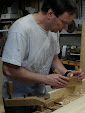
There are plenty of vague, impractical reasons why to use hand tools: it keeps the tradition alive, it brings you closer to the wood, it's more satisfying, it's fun. Poetic perhaps, but not very convincing for some, who would just as soon skip the hand tools for power tools.
But there is one very practical reason: you don't have to use power tools. Part of my goal here is to escape limitations.
How are power tools a limitation? For those who can't afford them or don't have space for them, typically hobbyists rather than professionals, the assumption that you need them is a limitation. It limits your thinking about where you can work. It makes you believe that without them, you can't work.
We're overwhelmingly programmed by school shop class, TV shows, magazines, and marketing to assume that we can't live without power tools. Most messages about working with hand tools get drowned out.
I can remember when I was in middle and junior high school taking wood shop, wanting to make stuff at home. But we always lived in apartments or rented houses, with neither the space nor the money for the big tools I was learning to use. It was frustrating. When I was older, even though I was starting to earn some money, I still didn't have the space I thought I needed for that real woodworker's shop.
Yet, for most of that time, we had basement space, a few empty square feet, or a small spare room. I could have set up a modest hand tool workshop almost from the beginning. I could have gotten by with as little as 4' x 6' of floor space.
Granted, it's debatable whether I as a teenager would have been receptive to working with hand tools. Perhaps in the arrogance of youth I would have viewed them as useless relics. But certainly once I was in my twenties, I would have been willing.
Had I started as a kid, I would now have nearly 40 years of experience with them. That's a lot of missed opportunity. Don't let that happen to you. All it takes is a little space and a few hundred dollars, and you can get started now. Don't wait decades.
Let's take a look at what I could have done in that time:
- Up to junior high, we lived in an apartment that didn't really have any spare space. But I did know a guy who rented a two-bedroom townhouse unit and used the extra room to build museum ship models.
- For the rest of the time until I graduated from high school, we lived in several rented houses with small basements. These would have been perfect, plenty of room for a small bench, toolchest, and sawing space.
- After college, I lived in a one-bedroom apartment. Since all the furniture I had was a bed, a folding chair, and a dinette with two chairs, I could have put a canvas drop cloth down and used part of the living room for a work area.
- After I got married, we lived first in a studio apartment with a big space under the stairs, then in a two-bedroom apartment where I used the extra room as an office. Again, room for a bench and tool chest on a drop cloth.
- Our first house was a ranch style. I bought a Shopsmith and tried to work in the garage. In Texas. Where in the summer time (all but two months of the year) a garage is just a giant solar oven. I didn't get much done. Meanwhile, it had a small extra bedroom with a linoleum floor. That would have been an ideal shop, comfortably air-conditioned.
- When we moved to Massachusetts, we spent a few years in rented houses with basement space, then bought a 1910 house with a divided basement. While the tiny designated workshop area was cramped even for the Shopsmith, it would have been just fine for a hand tool shop.
- When we bought our current house, I staked claim on a quarter of the basement. But I still had to keep the noise down for the rest of the family. Then I "took my vow" and worked toward the shop you've seen here.
You can work without the noise and clouds of sawdust that power tools produce. The only thing that might disturb the neighbors is pounding on chisels with a mallet for dovetails and mortises, but there are techniques that don't require heavy pounding. Saw or drill out the bulk of the waste, then pare the rest.
You might have to work at a smaller scale, maybe small cabinets and boxes instead of full dressers and highboys. You might only be able to keep the lumber on hand for the current project, and have to break it down into manageable pieces outside. But you can still work at the highest level of craftsmanship.
Hand tools are also fully portable. You can work anywhere, indoors or out. Yes, there are portable power tools, but what do you when there's no power (and you're batteries have run out)? Hand tools work just the same under third-world conditions as under first-world conditions.
Most hand tool skills taken individually can be learned easily with a bit of practice. It just takes a little time and patience, which will be richly rewarded. It's true there are many skills to master, and the total can be intimidating, but it's really no different with power tools. Either way, you have to learn how to do a variety of operations at rough and fine levels. Some of them require quite complicated setups and jigs with power tools.
The place where power tools really shine is for repetition, which is much more the domain of professionals in production mode. When you have hundreds of board feet to process or need to make 50 pieces all the same, power tools are worthwhile. Time invested in building and setting up custom jigs is amortized over many pieces. That's where power tools truly are labor-saving devices, and it's perfectly sensible to use them if you have access to them.
But that's not the scale that hobbyists work at. They're usually making one thing at a time, or at most, a small set. Any repetition is limited to a small number. So the labor-saving argument is less compelling; combined with a lack of access to power tools, hand tools make a lot of sense.
The reason I've "taken my vow of hand tools" is that I want to learn to do all the different operations by hand, so that nothing will be out of bounds. I remember the frustration I felt as a kid. If I keep opting for the power tool methods, I'll never learn the hand tool methods.
So escape your limits. Free your mind, and your skills will follow.


 Posts
Posts